
Corrosion-Resistant Piping Solutions for Water, Wastewater & Industrial Applications
At HalfPipeSleeve, our Cement Lined Pipes and Spools range is engineered to protect steel, ductile iron, and cast iron piping systems from internal corrosion while delivering smooth, efficient flow characteristics. This category covers the complete piping package – Cement Lined Pipes, Cement Lined Fittings, Cement Lined Flanges, and prefabricated Cement Lined Spools – built to meet the demands of drinking water, cooling water, firewater, sewage, and process piping systems.
What is Cement Lining?
This barrier works through two combined mechanisms:
- Physical barrier protection – the cured cement layer physically separates the corrosive fluid from the base metal.
- Alkaline passivation – hydrated cement carries a high pH (around 12.5), which promotes a passive oxide film on the metal surface and further resists corrosion.
The result is a piping product that resists rust, tuberculation, and scale build-up far longer than unlined steel or ductile iron, while also providing a smooth bore that improves hydraulic flow and reduces pumping energy losses.
Our Product Range

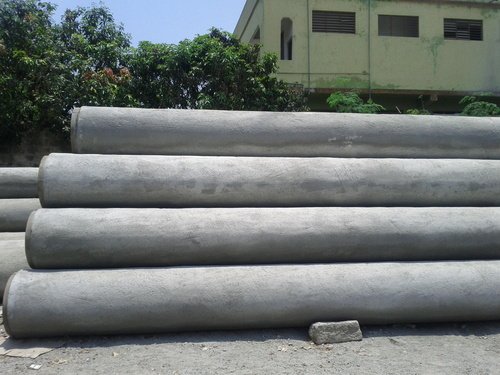
Cement Lined Pipes
Available in carbon steel, ductile iron, and cast iron, cement lined pipes are typically produced from NPS 2" up to NPS 84" (straight pipe lengths up to ~18 m). Lining is applied using high-capacity spray and centrifugal casting machines that uniformly distribute cement mortar against the inner pipe wall, producing a dense, smooth lining bonded to the steel.
Cement Lined Fittings
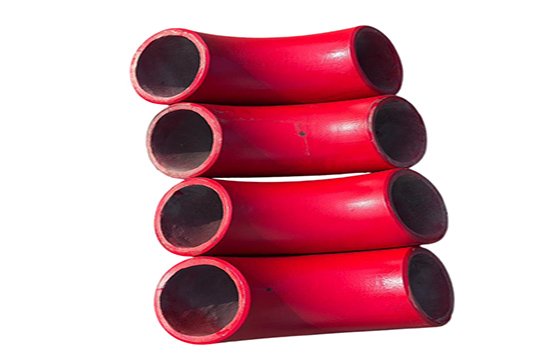
Elbows (90° & 45°), tees (straight & lateral), reducers (concentric & eccentric), crosses, end caps, bends (3D/5D), 180° returns, and saddles - manufactured to ASME B16.9 butt-weld fitting dimensions and lined per AWWA C205 standards. Due to the irregular bore geometry, fittings are typically hand-troweled or spray-lined, sometimes assisted by pneumatic placement tools, to ensure a compact and smooth internal finish.
Cement Lined Flanges
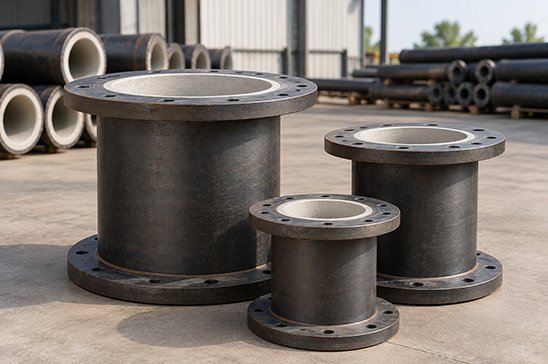
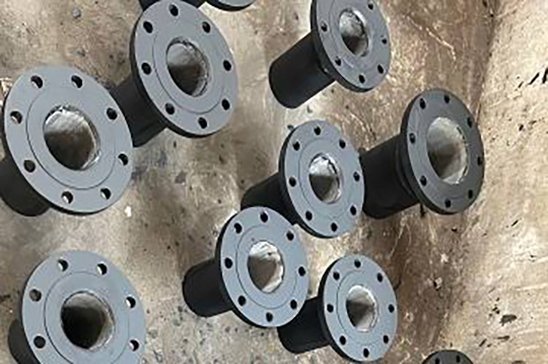
Flanges of any size and rating can be internally cement lined by hand-trowelling or spray application, maintaining lining continuity across flanged joints and ensuring the entire flow path - not just the straight pipe run - is corrosion protected.
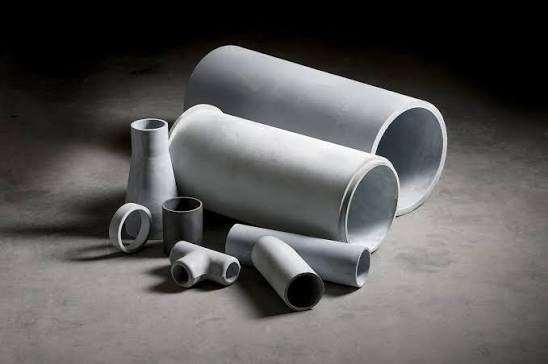
Cement Lined Spools
Prefabricated pipe spools combine pipe, fittings, and flanges into shop-welded assemblies with cement lining applied and cured before dispatch. Spool fabrication reduces field welding, shortens installation time, and ensures consistent lining quality under controlled shop conditions rather than in the field.
Key Benefits
- Corrosion Protection - Forms a durable barrier against saltwater, hydrogen sulfide, CO₂, brine, dilute acids, and other aggressive media, extending service life and cutting maintenance costs.
- Smooth Hydraulic Bore - A uniform cement surface reduces internal friction, improving flow efficiency and lowering pumping energy requirements compared to bare steel.
- Long Service Life - Properly installed and cured cement lining systems are known for decades of reliable service in municipal and industrial pipelines.
- Cost-Effective - Compared to exotic alloys or specialty coatings, cement lining offers strong corrosion resistance at a comparatively low cost.
- Material Compatibility - Works effectively with carbon steel, ductile iron, and cast iron base pipe.
- Wide Temperature Range - Suitable for continuous service up to approximately 212°F (100°C) in most configurations.
Typical Applications
- Drinking / potable water distribution systems
- Firewater and fire-protection loops
- Cooling water systems (power plants, industrial cooling towers)
- Raw water and seawater intake lines
- Sewage and wastewater transport
- Slurry and water injection lines (oil & gas)
- Oil field flow lines, casing, and tubing exposed to saltwater, H₂S, and CO₂
- Brine handling in salt works
- Corrosive discharge lines in mining and coal operations
- Diluted acid and corrosive waste lines in pulp & paper mills
- Process plants where product purity must be protected from iron/rust contamination
Manufacturing & Lining Process
- Surface Preparation - Pipe, fitting, or flange bore is cleaned and prepped prior to lining.
- Mortar/Concrete Mixing - A controlled ratio (typically ~1 part cement to 3 parts fine sand) is mixed with water to the correct workability; concrete (with coarse aggregate) is generally used for larger sizes (24" and above), while cement-mortar is common up to 20".
- Application - Straight pipe sections are lined using high-capacity spray/centrifugal casting machines for a dense, uniform bond; fittings, flanges, and irregular geometries are hand-trowelled or spray-lined.
- Curing - Lined components are cured under controlled conditions (moist curing or accelerated curing) to develop proper hydration and bond strength.
- Inspection - Lining thickness, surface finish, and bond quality are checked against project specifications before dispatch.
- External Coating - The outer surface is typically finished with a protective coating (e.g., black paint or per client spec) after curing.
Lining Thickness Guide (Reference)
Nominal Pipe Size | Typical Mortar Lining Thickness |
2″ – 10″ | 1/4″ |
12″ – 22″ | 5/16″ |
24″ and above | 3/8″ – 1″ (concrete lining) |
Actual lining thickness depends on project specification, fluid corrosivity, and the gover
Jointing Options
Cement lined systems can be joined using:
- Buttweld joints – commonly used for larger sizes (>24″), with the cement lining stopped short of the weld area and made good with mortar patching after welding.
- Sleeve joints – a jointing sleeve is shop-welded to one end, with the field weld completed on-site; a jointing compound seals the mating faces.
- Flanged joints – widely used where disassembly or maintenance access is required.
- Screwed/seal-ring joints – used on some smaller cement-lined pipe systems to keep corrosive media away from exposed steel at the joint.
Careful field jointing and inspection are essential – improperly repaired cement at joints or branch penetrations (e.g., weld-o-lets, thread-o-lets) can trap corrosive fluid between the lining and pipe wall, leading to premature failure. Bleed rings and reducing tees are commonly specified to minimize this risk.
Standards We Work To
- AWWA C205 – Cement-Mortar Lining for Steel Water Pipe
- AWWA C104/A21.4 – Cement-Mortar Lining for Ductile-Iron Pipe and Fittings
- ASME B16.9 – Factory-Made Wrought Buttwelding Fittings
- ASTM A234 / WPB – Fittings material grade
- ASTM C541 – Linings for Asbestos-Cement Pipe (reference standard)
- Client-specific and project-specific lining specifications
Why Choose HalfPipeSleeve
- Complete category coverage: pipes, fittings, flanges & fabricated spools in one place
- Lining applied and cured under controlled, quality-checked conditions
- Compatible with carbon steel, ductile iron, and cast iron base materials
- Manufactured to recognized international standards (AWWA / ASME / ASTM)
- Suitable for both new pipeline construction and MRO/replacement projects
- Technical support for lining selection, thickness, and jointing method
Need a cement lined pipe, fitting, flange, or spool built to your specification?
Contact our team with your size, pressure class, and service conditions, and we'll help you specify the right lining thickness, joint type, and material grade for your project.
Email sales@halfpipesleeve.com