
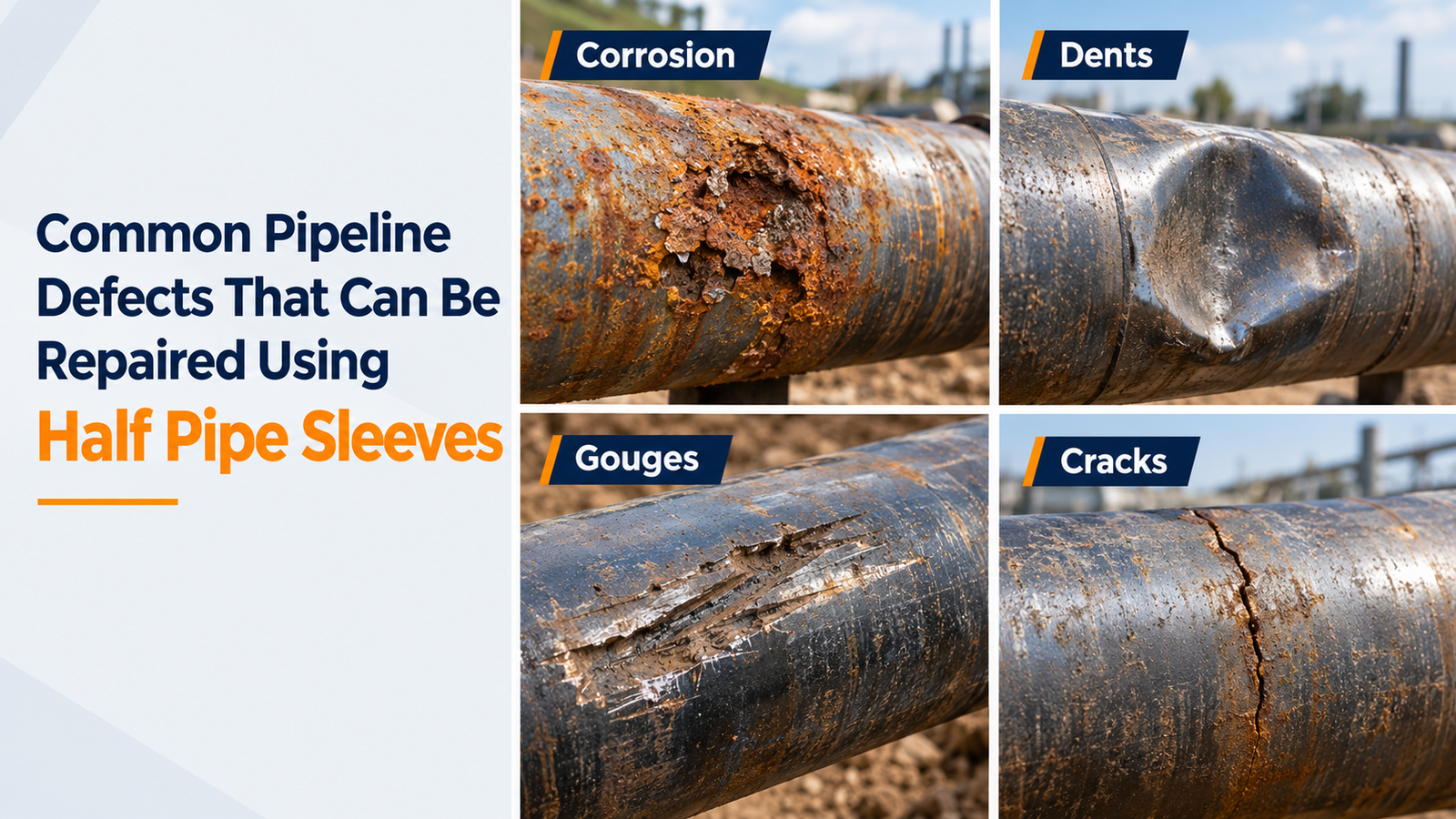
Pipelines operate in demanding environments. Over time, they may experience corrosion, mechanical damage, dents, gouges and other defects.
A half pipe sleeve may be considered for certain localised defects when an engineering assessment confirms that reinforcement is appropriate.
Six Common Defects
External Corrosion
External corrosion can gradually reduce pipe wall thickness.
If corrosion is detected early enough, engineers may evaluate whether reinforcement can restore the required structural capacity.
A sleeve can provide additional material around the affected section.
Localised Wall Loss
Wall thinning can occur due to corrosion or erosion.
The remaining wall thickness and extent of damage need to be evaluated before deciding on a repair.
Gouges
Gouges are mechanical defects that can occur during construction, handling or operation.
Depending on their depth, orientation and associated stresses, a gouge may require removal, repair or reinforcement.
Dents
Dents can alter the geometry of a pipeline and may be associated with additional damage.
A sleeve is not automatically appropriate for every dent. Engineering evaluation is required to determine the correct solution.
Weld-Related Defects
Pipeline welds can develop imperfections that require assessment.
The repair method depends on the type, location and severity of the weld defect.
Punctures and Localised Damage
Some pipeline damage can be concentrated in a relatively small area.
A targeted sleeve may provide reinforcement without replacing a much larger pipeline section, subject to engineering approval.
Factors That Determine Sleeve Suitability
Before selecting a half pipe sleeve, consider:
- Pipe diameter
- Pipe wall thickness
- Material grade
- Defect size
- Defect location
- Operating pressure
- Operating temperature
- Service fluid
- Stress conditions
- Required remaining service life
Why Inspection Matters
Pipeline inspection provides the information needed to understand the condition of the pipe.
Inspection techniques may identify wall loss, cracks, dents and other anomalies.
The repair should be based on verified inspection information rather than visual assumptions alone.
Conclusion
Half pipe sleeves can be considered for several types of localised pipeline damage, including corrosion and mechanical defects.
However, the important question is not simply whether a sleeve can physically cover a defect. The repair must be engineered to address the actual condition of the pipeline.
Found a defect on your pipeline?
Share your pipe details and inspection data with our team.